
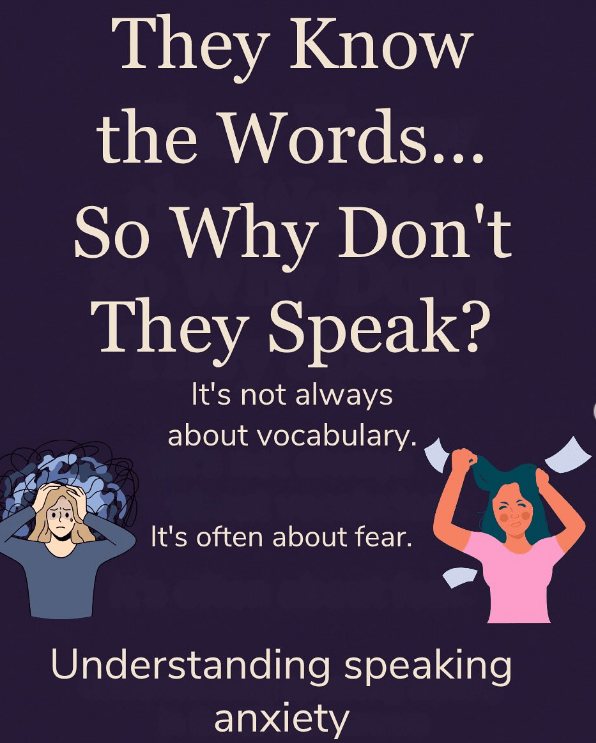
They Know the Words… So Why Don’t They Speak?
Have you ever had a student who aced vocabulary tests, completed every grammar exercise perfectly — but stayed silent during speaking activities?
It’s not always about vocabulary.
It’s often about fear.
What Speaking Anxiety Looks Like
Speaking in a second language isn’t just a skill—it’s an act of vulnerability. For many students, especially introverted or neurodivergent learners, speaking in front of others can trigger:
- Fear of being wrong
- Fear of being laughed at
- Fear of the spotlight
And what does this fear often look like?
👉 Head down, eyes avoiding contact
👉 Whispering or saying “I don’t know”
👉 Freezing completely when called on
They know the answer.
But the pressure of performance overrides access to that knowledge.
Why This Matters in Creative Classrooms
If we want to nurture creativity, we must first create safety. That means understanding that:
🧠 Anxiety blocks language retrieval
🧏 Participation doesn’t have to mean speaking aloud
🎨 Expression can take many forms—writing, drawing, acting, even silence
When we widen the definition of “participation,” we widen the circle of belonging.
What You Can Do as a Teacher
Here are a few ways to support students with speaking anxiety:
✅ Allow students to prepare answers in pairs or in writing before speaking
✅ Accept written or visual responses as valid contributions
✅ Celebrate effort, not just accuracy
✅ Use role-play and games to reduce pressure
✅ Avoid putting students on the spot without warning
Final Thought
Sometimes, the loudest learners get the most attention.
But the quiet ones are thinking too.
They just need the right conditions to feel safe enough to speak.
Let’s not confuse silence with absence.
Let’s listen beyond the noise.
 Creative English With Alpcan