
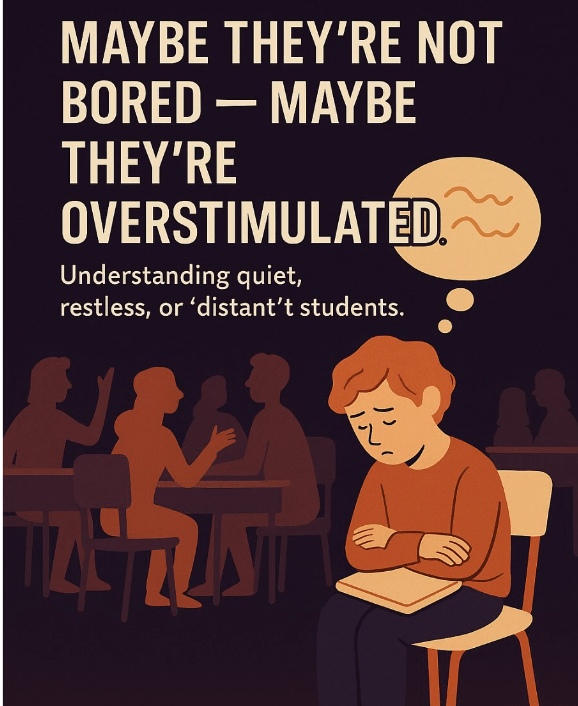
Maybe They’re Not Bored — Maybe They’re Overstimulated
In classrooms, it’s easy to misread silence, fidgeting, or a student who won’t sit still. But what if what looks like “disinterest” is something else entirely?
Not every student tunes out.
Some shut down.
Because the world around them is too loud, too fast, too much.
Rethinking “Disengagement”
In a creative classroom, we don’t rush to label behavior.
We slow down to listen. We pay attention not only to what’s loud, but also to what’s quiet.
What if:
- 🧠 Silence is a form of self-regulation?
- 🎧 Fidgeting is actually focus?
- 🚶♂️Leaving the seat signals a need, not a problem?
Every student’s nervous system is different. And when we assume every child should respond the same way, we risk missing what they’re actually telling us—without words.
A Call for Compassionate Classrooms
Instead of asking, “Why won’t they sit still?”,
We can ask, “What does their body need to feel safe right now?”
Instead of asking, “Why aren’t they participating?”,
We can wonder, “What does engagement look like for them?”
When we shift the question, we shift the relationship.
Let’s Create Spaces Where All Minds Can Bloom 🌱
In a truly inclusive classroom, students don’t have to mask or shrink themselves to belong.
They can regulate, process, and participate in their own rhythm—whether that’s through movement, stillness, drawing, whispering, or just being.
Because learning doesn’t begin with control.
It begins with safety.
And safety begins with understanding.
 Creative English With Alpcan